
The Subtle Art of Human Design

Photo by Unsplash
Lucy Skinner 23/06/2026
Artificial Intelligence (AI) is still a divided topic, particularly amongst us creatives.
On one hand, the efficiencies are undeniable. Tasks that once took hours now take seconds. I remember painstakingly isolating images from backgrounds with a brush to get the level of detail I demanded. Now, one click, a bit of refinement, done. Honestly, that’s a win. It frees me up to focus on the parts of design that actually matter.
But here’s what’s interesting.
The fear we felt 12 months ago has largely dissipated. It’s been replaced with something else, curiosity, and even a renewed sense of purpose in what we do.
Because once you push generative AI beyond the basics and really put it to the test, something becomes clear.
It can do almost everything, but it does it in a very particular way.
Consistent. Polished. Technically “good”.
And yet, often, slightly generic. A bit predictable. If I’m honest? A bit boring.
That’s not just a personal opinion either. Research is starting to show the same pattern, that while AI can improve the quality of individual outputs, it often reduces diversity of ideas, with people arriving at very similar solutions when using the same tools.
In creative work, that’s a problem.
“…while AI can improve the quality of individual outputs, it often reduces diversity of ideas…”
Where AI Falls Short
When it comes to actual design thinking, identity, storytelling, emotional connection, AI still struggles.
It produces based on probability. Patterns. What is most likely to work.
But great design doesn’t live in the “most likely.”
It lives in nuance. In experience. In instinct.
Studies continue to show that while AI work can look impressive, people still place greater value on human-created work, often connecting it with a deeper sense of intention, effort, and meaning.
And that makes sense.
Because design isn’t just output, it’s intention.
A Real Example
When I started this agency, I had the opportunity, and the excuse, to create a new logo.
I enjoyed every part of the process, from concept to execution. The decisions weren’t random. They were layered with meaning, intention, and context that only comes from lived experience.
Naturally, I tested AI against it.
I gave it clear prompts. Strong direction. Multiple attempts.
And to be fair, it didn’t do a bad job.
But it didn’t do a good job either.
It missed the detail. The restraint. The subtle decisions that don’t scream for attention but quietly shape how a brand feels.
What it produced was fine.
But fine doesn’t build brands.
Fine doesn’t create connection.
Fine doesn’t last.
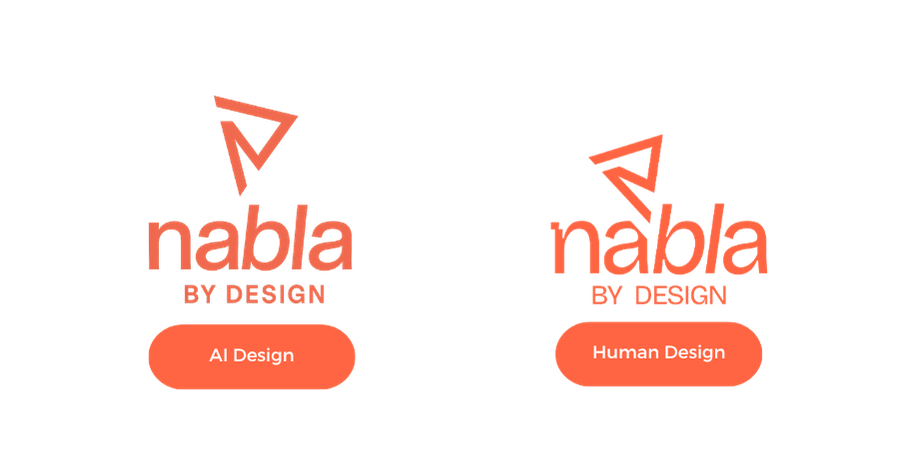
Examples from our own research.
The Real Opportunity
This isn’t about AI vs humans.
It’s about understanding where each excels.
AI is exceptional at:
Speed
Scale
Execution
Raising the baseline of output quality
But it struggles with:
Originality at scale
Emotional depth
Contextual meaning
True creative risk
In fact, studies of human AI co-creative design show that AI works best when it is supporting refinement and execution, while the real creative direction still relies on the experience and judgement of the designer.
That feels about right.
Conclusion
AI hasn’t replaced creativity.
If anything, it has clarified it.
It has removed the technical barriers, sped up the process, and levelled the playing field, but in doing so, it has made one thing more obvious than ever:
The real value of design isn’t in the execution.
It’s in the thinking behind it.
In the subtle decisions.
The lived experience.
The emotional intelligence.
The things you can’t quite articulate, but you know when they’re there.
Or when they’re not.
And maybe that’s the point.
In a world where everything can be generated, the most valuable thing we can bring to the table is being human.
